


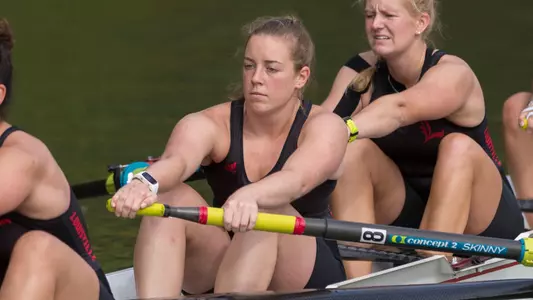
Caroline Lynch rowing during the fall of 2017.
Novice Rowers Find Varsity Success at Louisville
September 13, 2018 | Rowing
Novice program essential to building Cardinals’ roster since first season in 1999
LOUISVILLE, Ky. - As preparations begin for the upcoming season, the University of Louisville rowing team is hard at work, training daily at the G. Garvin Brown III Rowing Center. For many, it's a return to the grinding schedule of years past, but for others, it is the beginning of a completely new experience. These student-athletes are part of a program that is unique to rowing: the novice team.
Although most of Louisville's rowers were recruited by head coach Derek Copeland and his staff, a small portion of the team is comprised of novices, typically freshman walk-ons who are new to the sport. The use of novices traces back to the beginning of the Louisville rowing program in 1999, when newcomers were used to start the team. Throughout the country, many schools field teams completely comprised of novices, specifically at the club level.
The process begins each fall as coaches and players attend freshman orientation and Welcome Week events, promoting the team to prospective new members, garnering around 35 interested students.
"I was recruited on campus by the coaches," said sophomore McKenzie Vaughn. "I got a letter in the mail that said, 'Be one of the grittiest girls you know,' and I was sold.
After showing interest, the novices head to a meeting with assistant coach Hannah Ritter, a former Louisville novice herself and current program director.
"The novice team is essential to the support of the varsity team, because each year, the novices show up with no ideas what they're doing and inject a huge dose of excitement about rowing into the group," said Ritter, who began as a novice before reaching the varsity eight crew in her 2014 senior season. "They've just discovered a new sport that's really fun, if a bit strange, and they bring that with them to every practice."
Many novices enter the program with athletic experience, previously competing in sports such as soccer, basketball, track and swimming, but few had Division I sports on their radars as they started college.
"I had vaguely heard of the sport the summer coming into my freshman year," said Sophie Schulz, a former novice who finished her career last spring as a CRCA Second Team All-American. "I knew a family friend that joined the team when I was in high school, but I didn't put two and two together until I was approached on campus to join the team."
"I had never touched a rowing machine before," added senior Caroline Lynch. "I was just interested in a team sport, so I decided to try it out, and they taught us everything we needed to know."
In addition to taking on the challenge of learning a new sport, novices must adjust to both the early morning schedule and taxing toll exerted in training. They learn the mechanics of rowing and develop power using the erg machine, forcing them to make physical adjustments.
"I think the constant cardio that we do I was not used to," said Lynch. "In basketball, you get breaks during things. You run up and down the court, and once you're there, you're there. You can breathe a little bit. But I feel with rowing, you have to keep going until the whole piece is done. And so, I think that was a real shocker."
"The biggest adjustment was managing my schedule," said Schulz. "I had enough time to do everything I needed, but I had to be diligent about time management, so that I wouldn't get stressed out. I was never messy or disorganized, but it taught me to use a calendar and write everything down."
Despite the difficulties, a small group of novices eventually break through each year and begin transitioning to the water, eventually leading to their first taste of competition in the late fall and early spring. In a given year, the number of novices incorporated into the varsity squad by the end of spring competition can range from five to as many as 16, the tally from Schulz's freshman year. For rowers like Lynch, the result brings an unexpected, yet welcome addition to their collegiate life.
"I think that the team was exactly what I wanted," said Lynch. "All the girls were so similar to me, and with the competitive and supportive team we have, it made the adjustment worth it to me."
With the success of the program, Ritter is looking forward to growing the pool of newcomers and like many of the previous novices, she is drawn toward students with athletic experience.
"We're excited to start expanding the novice program by recruiting athletes from other sports to Louisville with the intention of teaching them how to row through the novice team," said Ritter. "We've had a few of these athletes in the program, who could have gone DI or DII in another sport, but needed a change, and they've been so successful that we're starting to consider this as the future of the novice program."
Schulz added that future novices will succeed if they possess the willingness to push themselves farther than they believed possible and if they trust their coaches and teammates in team-oriented environment. Now viewing the process from the coaching side, she said her motivation to help was the ability to connect with those now in her shoes. Ritter shared that she is hoping to develop a novice class with better technical skills earlier in the season, in addition to the raw power displayed by past groups.
Regardless of experience and skill, she holds the novice program as an integral factor to Louisville's success and a benefit to their more experienced teammates.
"The enthusiasm makes the varsity squad reflect on why they originally got into rowing, and reminds them that, as hard as it is, rowing should be fun!" said Ritter. "The novices also show the varsity squad that sometimes cluelessness is a weapon – novices have no idea what they're capable of, and often turn out to be impossibly fast, simply because they don't know any differently."
Fans can follow Louisville rowing on Twitter (@UofLrowing) at http://twitter.com/uoflrowing, on Facebook at https://www.facebook.com/UofLRowing and on Instagram at http://www.instagram.com/uoflrowing.
Although most of Louisville's rowers were recruited by head coach Derek Copeland and his staff, a small portion of the team is comprised of novices, typically freshman walk-ons who are new to the sport. The use of novices traces back to the beginning of the Louisville rowing program in 1999, when newcomers were used to start the team. Throughout the country, many schools field teams completely comprised of novices, specifically at the club level.
The process begins each fall as coaches and players attend freshman orientation and Welcome Week events, promoting the team to prospective new members, garnering around 35 interested students.
"I was recruited on campus by the coaches," said sophomore McKenzie Vaughn. "I got a letter in the mail that said, 'Be one of the grittiest girls you know,' and I was sold.
After showing interest, the novices head to a meeting with assistant coach Hannah Ritter, a former Louisville novice herself and current program director.
"The novice team is essential to the support of the varsity team, because each year, the novices show up with no ideas what they're doing and inject a huge dose of excitement about rowing into the group," said Ritter, who began as a novice before reaching the varsity eight crew in her 2014 senior season. "They've just discovered a new sport that's really fun, if a bit strange, and they bring that with them to every practice."
Many novices enter the program with athletic experience, previously competing in sports such as soccer, basketball, track and swimming, but few had Division I sports on their radars as they started college.
"I had vaguely heard of the sport the summer coming into my freshman year," said Sophie Schulz, a former novice who finished her career last spring as a CRCA Second Team All-American. "I knew a family friend that joined the team when I was in high school, but I didn't put two and two together until I was approached on campus to join the team."
"I had never touched a rowing machine before," added senior Caroline Lynch. "I was just interested in a team sport, so I decided to try it out, and they taught us everything we needed to know."
In addition to taking on the challenge of learning a new sport, novices must adjust to both the early morning schedule and taxing toll exerted in training. They learn the mechanics of rowing and develop power using the erg machine, forcing them to make physical adjustments.
"I think the constant cardio that we do I was not used to," said Lynch. "In basketball, you get breaks during things. You run up and down the court, and once you're there, you're there. You can breathe a little bit. But I feel with rowing, you have to keep going until the whole piece is done. And so, I think that was a real shocker."
"The biggest adjustment was managing my schedule," said Schulz. "I had enough time to do everything I needed, but I had to be diligent about time management, so that I wouldn't get stressed out. I was never messy or disorganized, but it taught me to use a calendar and write everything down."
Despite the difficulties, a small group of novices eventually break through each year and begin transitioning to the water, eventually leading to their first taste of competition in the late fall and early spring. In a given year, the number of novices incorporated into the varsity squad by the end of spring competition can range from five to as many as 16, the tally from Schulz's freshman year. For rowers like Lynch, the result brings an unexpected, yet welcome addition to their collegiate life.
"I think that the team was exactly what I wanted," said Lynch. "All the girls were so similar to me, and with the competitive and supportive team we have, it made the adjustment worth it to me."
With the success of the program, Ritter is looking forward to growing the pool of newcomers and like many of the previous novices, she is drawn toward students with athletic experience.
"We're excited to start expanding the novice program by recruiting athletes from other sports to Louisville with the intention of teaching them how to row through the novice team," said Ritter. "We've had a few of these athletes in the program, who could have gone DI or DII in another sport, but needed a change, and they've been so successful that we're starting to consider this as the future of the novice program."
Schulz added that future novices will succeed if they possess the willingness to push themselves farther than they believed possible and if they trust their coaches and teammates in team-oriented environment. Now viewing the process from the coaching side, she said her motivation to help was the ability to connect with those now in her shoes. Ritter shared that she is hoping to develop a novice class with better technical skills earlier in the season, in addition to the raw power displayed by past groups.
Regardless of experience and skill, she holds the novice program as an integral factor to Louisville's success and a benefit to their more experienced teammates.
"The enthusiasm makes the varsity squad reflect on why they originally got into rowing, and reminds them that, as hard as it is, rowing should be fun!" said Ritter. "The novices also show the varsity squad that sometimes cluelessness is a weapon – novices have no idea what they're capable of, and often turn out to be impossibly fast, simply because they don't know any differently."
Fans can follow Louisville rowing on Twitter (@UofLrowing) at http://twitter.com/uoflrowing, on Facebook at https://www.facebook.com/UofLRowing and on Instagram at http://www.instagram.com/uoflrowing.


Players Mentioned



Thursday, September 11
Tuesday, January 24
Tuesday, January 14
Saturday, October 05


